
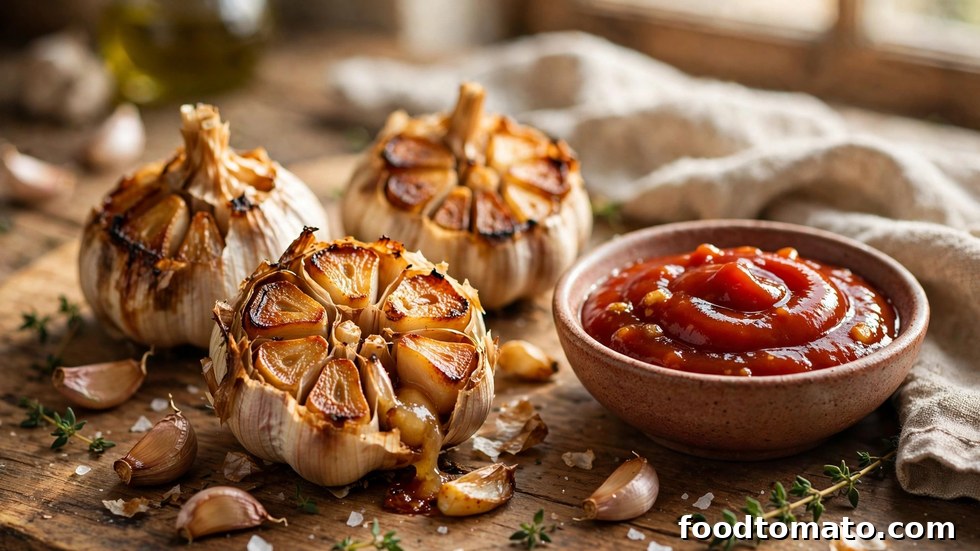
Roast garlic shows up in the world’s best kitchens for a reason: slow roasting turns its sharp, raw bite into something sweet, buttery, and almost caramel-like. Fold that into homemade tomato ketchup and you get a condiment that is rich, savory, and deeply satisfying — the kind that makes you close your eyes on the first taste. Roasted garlic ketchup keeps everything you love about classic ketchup, then layers in a mellow roasted depth that works on everything from grilled cheese to steak. And it is barely more work than plain ketchup: roast two heads of garlic while the tomatoes simmer, squeeze the soft cloves into the pot, and blend. One extra step, ten times the character.
Why Roasted Garlic Makes Ketchup Better
Raw garlic is pungent and aggressive; roasted garlic is a different ingredient entirely. An hour in the oven caramelizes its natural sugars and tames its harsh compounds, leaving soft golden cloves that taste sweet, nutty, and savory at once. That transformation is exactly what ketchup needs. Ketchup lives on the sweet-sour axis, and roasted garlic adds the missing third dimension — umami. It gives the sauce a savory backbone that tastes fuller and more complex without a single extra spice. Unlike raw garlic, which can dominate, roasted garlic melts into the background and supports the tomato flavor. The result tastes more like itself: richer, rounder, with a subtle roasted sweetness that keeps you coming back.
Ingredients
Makes about 3 cups (roughly 48 tablespoons).
- 2 whole heads of garlic (about 20 cloves)
- 2 tablespoons olive oil, divided
- 2 cans (28 ounces / 800 g each) crushed tomatoes
- 1 medium yellow onion, finely chopped
- 1/2 cup apple cider vinegar
- 1/3 cup dark brown sugar, packed
- 3 tablespoons tomato paste
- 2 tablespoons honey
- 1 teaspoon fine sea salt, plus more to taste
- 1/2 teaspoon black pepper
- 1/4 teaspoon ground allspice
- 1/4 teaspoon celery seed
- 1/8 teaspoon ground cloves
- 1/2 cup water
Step-by-Step Instructions
- Roast the garlic. Preheat the oven to 400°F (200°C). Slice the top 1/4 inch off each head to expose the cloves, drizzle with 1 tablespoon of olive oil each, wrap tightly in foil, and roast 40 to 45 minutes until soft and golden with caramelized edges. Squeeze the cloves out and mash into a paste with a fork.
- Sweat the onion. Meanwhile, heat the remaining oil in a large heavy pot over medium heat. Cook the onion 7 to 8 minutes until soft and lightly golden.
- Toast the paste and spices. Stir in the tomato paste, allspice, celery seed, and cloves. Cook 2 minutes, stirring, until the paste darkens and smells rich.
- Combine. Add the crushed tomatoes, water, vinegar, brown sugar, honey, salt, pepper, and the roasted garlic paste. Stir well.
- Simmer. Bring to a gentle boil, reduce to low, and simmer uncovered 55 to 70 minutes, stirring every 10 minutes, until thick and reduced by about a third.
- Blend smooth. Cool 10 minutes, then blend 2 to 3 minutes until completely silky. Press through a fine-mesh sieve for the smoothest result.
- Season and jar. Taste warm: add salt, vinegar, or honey to balance. Cool completely, funnel into clean jars, and refrigerate. The flavor is noticeably better after 24 hours as the garlic mellows into the tomato base.
Nutrition Facts
Per tablespoon (approximately 17 g):
| Nutrient | Amount |
|---|---|
| Calories | 20 |
| Total Fat | 0.2 g |
| Sodium | 85 mg |
| Total Carbohydrates | 4.6 g |
| Sugars | 3.9 g |
| Protein | 0.4 g |
| Fiber | 0.3 g |
Tips for the Best Roasted Garlic Ketchup
Roast the garlic properly
Do not under-roast. Pale, merely soft garlic tastes sharp in the finished ketchup; golden cloves with caramelized edges taste sweet and complex. If your oven runs cool, give the heads an extra 10 minutes — there is almost no risk of overdoing it while the foil stays sealed.
Mash the garlic into a true paste
Mashing the roasted cloves before they go into the pot helps them dissolve evenly during the simmer instead of sitting in chunks. It also lets you taste the garlic on its own and confirm it is sweet and roasted, not bitter.
Let it rest before judging
Freshly blended, the roasted garlic can taste surprisingly assertive. After a day in the fridge it relaxes and integrates. Taste again at 24 hours — that is the true flavor of the finished ketchup.
Variations and Flavor Adjustments
For an extra-roasty version, use a third head of garlic and a teaspoon of balsamic vinegar at the end — magnificent on meatball subs. For heat, add 1/2 teaspoon of red pepper flakes with the spices, or roast 2 jalapenos alongside the garlic. For a lighter, brighter version, use 1 head of roasted garlic plus 2 cloves of fresh garlic grated in at blending — roasted depth plus fresh sparkle. Cooking for garlic skeptics? Drop to 1 head; you still get lovely savory roundness without announcing the garlic.
Storage
Refrigerated in clean sealed jars, this ketchup keeps 5 to 7 weeks. For pantry storage, water-bath can in sterilized half-pint jars for 15 minutes; sealed jars keep up to a year. It also freezes well — pour into ice-cube trays and bag the cubes for up to 6 months. Serve with a clean spoon and discard at any sign of mold or off smells.
Best Ways to Use It
- Steak and roast beef — the savory garlic depth is a natural partner for red meat.
- Grilled cheese — spread a thin layer inside before grilling, or serve alongside for dipping.
- Burgers — especially mushroom Swiss or blue cheese, where the garlic bridges the flavors.
- Meatball subs — drizzle over meatballs in a toasted roll with melted provolone.
- Roasted potatoes — serve with crispy roast potatoes or wedges instead of plain ketchup.
- Pizza crust dip — warm it slightly and use it for dipping leftover crusts.
Frequently Asked Questions
Will this ketchup taste too garlicky?
Almost certainly not. Roasting converts garlic’s harsh compounds into sweet, mellow ones, so two heads taste like a rich savory background note. Most tasters cannot identify garlic specifically; they just say the ketchup tastes richer.
Can I roast the garlic ahead of time?
Yes — roasted garlic keeps up to a week in the fridge in a sealed container under a thin layer of olive oil. Roast a big batch on the weekend and use it for this ketchup plus pasta and spreads all week. It also freezes well.
Why does my ketchup taste bitter?
Bitterness almost always means the garlic burned. Garlic past deep golden turns bitter, and no sugar fully hides it. Keep heads wrapped tightly in foil, hold the oven at 400°F, and pull them when golden and soft.
Can I make this without a blender?
Press the simmered mixture through a food mill or fine-mesh sieve in batches — the roasted garlic is soft enough to push through easily. The texture will be slightly rustic, which some people prefer. An immersion blender is the easiest upgrade.
Key Takeaways
- Slow-roasting two heads of garlic converts sharp raw bite into sweet, buttery, caramelized depth — the secret behind this ketchup’s savoriness.
- Roast until the cloves are golden with caramelized edges, then mash into a paste so the garlic dissolves evenly into the simmering base.
- The garlic mellows and integrates after 24 hours in the fridge — judge the final batch the next day, not right after blending.
- Refrigerated it keeps 5 to 7 weeks, cans safely for a year, and freezes in tablespoon-sized cubes.
Once you taste what roasted garlic does for ketchup, plain ketchup starts to feel like it is missing something — because it is. Roast those heads of garlic, simmer a pot this weekend, and keep a jar in the fridge for everything from steak night to grilled cheese. Then browse our other homemade ketchup recipes for your next flavor project.