
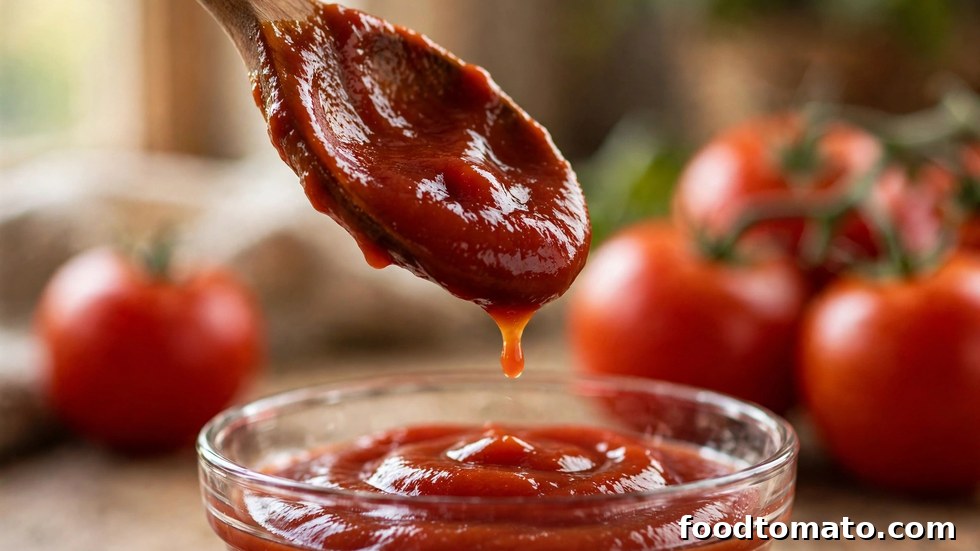
Ask ketchup lovers what makes the perfect bottle and most will talk about flavor — but ask a food scientist and they will talk about texture. Consistency is the hidden half of great ketchup. Too thin and it runs off your fries into a sad puddle; too thick and it will not leave the jar without a fight. The ideal ketchup flows when you want it to, then holds its shape on the plate. Getting there reliably is not luck — it is a matter of understanding pectin, reduction, and a few simple tests. This guide gives you the complete playbook for nailing ketchup texture every single time.
What “Perfect” Consistency Actually Means
Perfect ketchup consistency has a technical definition, and it is surprisingly precise. Food scientists measure it with a Bostwick consistometer: ketchup should flow between 3 and 7 centimeters in 30 seconds under its own weight. In kitchen terms, that translates to three observable qualities. First, it pours or squeezes out with gentle pressure but does not gush. Second, a dollop holds its shape on a plate without spreading into a flat disc. Third, no watery liquid separates and pools around the edges — a defect called syneresis. If your ketchup does all three, its texture is spot on, regardless of what any recipe says.
The Science: Pectin, Reduction, and Solids
Three forces control ketchup thickness. The first is pectin, the natural gelling fiber in tomatoes. Pectin is concentrated in the skins and the gel around the seeds — which is exactly why straining out every last bit of pulp can actually make ketchup thinner. The second force is reduction: simmering evaporates water and concentrates everything else, which is the primary way homemade ketchup thickens. The third is total solids — the dissolved sugars, salts, and tomato matter that give the sauce body even before pectin sets.
Here is the practical takeaway: ketchup thickens through a combination of cooking out water and letting pectin do its work as the sauce cools. That is why a batch that looks slightly thin in the pot often sets up perfectly in the jar overnight. Patience is literally an ingredient.
Choosing Tomatoes for Thickness
Your tomato choice sets the ceiling for how thick your ketchup can get with reasonable cooking time. Paste tomatoes like Roma and San Marzano contain roughly twice the solids of watery beefsteak or heirloom varieties, so they reach target consistency in 20-25 minutes of simmering instead of 40-50. If you are working with juicy salad tomatoes, you can compensate by adding 2-3 tablespoons of tomato paste per 2 pounds of tomatoes — it is essentially pre-reduced tomato solids and jump-starts the thickening process without changing the flavor.
Canned tomatoes vary too. Canned whole peeled tomatoes packed in juice are thinner than those packed in purée, and crushed tomatoes fall somewhere in between. When a recipe’s timing does not match your results, the tomato product is usually the reason — adjust the simmer, not your expectations.
The Reduction Method: Step by Step
Reduction is the most reliable thickening method because it concentrates flavor at the same time. Follow this process after your ketchup is blended, strained, and seasoned:
- Use a wide pot. A wide saucepan or skillet exposes more surface area, so water evaporates faster. A tall narrow pot can double your reduction time.
- Simmer, never boil. Keep the heat at a gentle bubble — a hard boil breaks down pectin and can scorch the sugars. Medium-low is the sweet spot.
- Leave it uncovered. The lid traps steam and defeats the purpose. If splattering is a problem, use a splatter screen, not a lid.
- Stir on a schedule. Stir every 3-4 minutes early on, then every 1-2 minutes as it thickens. The bottom scorches fastest in the last 10 minutes.
- Test, do not guess. Start testing at the 15-minute mark using the plate test below. Check every 5 minutes after that.
The Plate Test: Your Most Reliable Tool
Forget timers — the plate test tells you the truth. Spoon a small amount of ketchup onto a cold plate (keep one in the freezer while you cook) and let it sit for one minute. Then tilt the plate. Perfect ketchup will creep slowly and leave only the faintest trail of clear liquid, if any. If it runs like soup, keep simmering. If a wide ring of watery liquid separates around the mound, you have syneresis — keep cooking until the liquid reabsorbs. If it barely moves at all, you have gone too far; whisk in warm water one tablespoon at a time until it loosens.
The second test is the spoon test: dip a spoon in the pot and draw a line across the back with your finger. If the line holds clean edges without the ketchup running back together, you are done. Always judge by the cooled sample, not the hot pot — ketchup thickens noticeably as it cools, and overshooting is the most common beginner mistake.
Fixing Texture Problems
| Problem | Likely Cause | Fix |
|---|---|---|
| Too thin | Under-reduced; watery tomatoes | Simmer uncovered 10-15 min more, stirring often |
| Too thick | Over-reduced | Whisk in warm water, 1 tbsp at a time |
| Watery separation | Syneresis; served too soon | Simmer longer; chill 24 hours before judging |
| Grainy or gritty | Ground spices not strained | Re-strain through fine-mesh sieve |
| Lumpy | Incomplete blending | Re-blend with immersion blender until smooth |
| Thin after storage | Pectin broken by freezing or long storage | Stir well; simmer 5 min to re-thicken if needed |
Natural Thickeners: When Reduction Is Not Enough
Sometimes you want to thicken ketchup without cooking it down further — maybe the flavor is already perfectly balanced and more simmering would dull it. In that case, a small amount of tomato paste (1-2 tablespoons per cup of ketchup) stirred in and simmered for just 5 minutes adds body with minimal flavor change. A teaspoon of cornstarch dissolved in cold water works in a pinch, but it can give a slightly glossy, commercial texture that some cooks dislike. Avoid flour — it clouds the color and mutes the bright tomato flavor. The cleanest approach remains patience: a proper reduction beats every shortcut.
Frequently Asked Questions
Why is my homemade ketchup thinner than Heinz?
Commercial ketchup uses tomato concentrate (essentially tomatoes reduced in a factory evaporator), added thickeners like xanthan gum, and precise solids control. Your homemade version relies on a stovetop reduction and natural pectin. You can get very close with paste tomatoes and a patient simmer — aim for the plate test rather than trying to match the bottle exactly.
Does ketchup really thicken as it cools?
Yes, significantly. Pectin forms its gel network as the temperature drops, so ketchup that looks slightly loose in the hot pot will firm up in the jar. This is why experienced cooks stop reducing when the ketchup is just a touch thinner than the target. Judge the final texture after at least 4 hours of chilling, ideally 24.
Can I fix ketchup that separated in the jar?
Often, yes. A thin layer of liquid on top after storage is usually harmless syneresis — just stir it back in. If the whole jar is watery, pour it back into a pot and simmer for 5-10 minutes to re-reduce, then re-jar. Persistent separation usually means the batch was under-reduced in the first place.
Should I add pectin powder to my ketchup?
It is rarely necessary. Tomatoes contain enough natural pectin for a good set, especially paste varieties. Added pectin can create a jam-like, overly firm texture that does not pour well. If you want to experiment, use no more than 1/2 teaspoon of powdered pectin per 2 cups of ketchup, whisked with the sugar before adding.
Key Takeaways
- Perfect ketchup pours with gentle pressure, holds its shape on a plate, and shows no watery separation.
- Thickness comes from natural pectin plus water reduction — paste tomatoes and a wide, uncovered pot get you there fastest.
- Judge doneness with the cold plate test, not the clock; ketchup thickens further as it cools, so stop slightly early.
- Thin ketchup needs more simmering, thick ketchup needs a splash of water — almost every texture problem is fixable.
Consistency is a skill, not a mystery — and now you have the tests and fixes to master it. Next time you simmer a batch, keep a cold plate handy, trust the spoon test, and remember that patience thickens better than any shortcut. Try it on your next batch and taste the difference that perfect texture makes.