
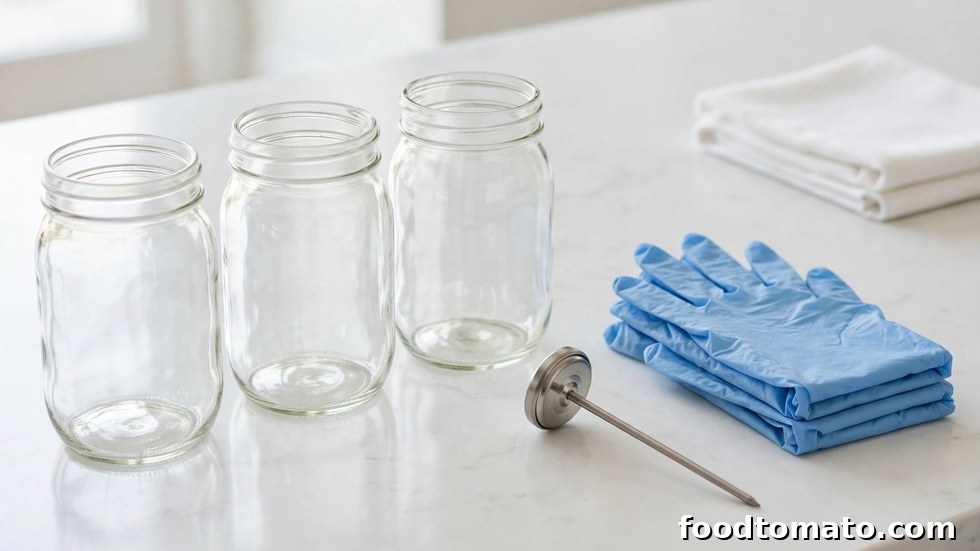
Let us talk plainly about botulism, because it is the one risk in home canning that deserves your full respect — and also the one that is easiest to eliminate completely. Botulism is caused by a toxin produced by the bacterium Clostridium botulinum, whose spores can survive boiling water and then grow in a sealed, low-acid, room-temperature jar. Tomatoes are naturally borderline in acidity, which is why tomato products have specific, well-tested safety rules. The good news: if you follow those rules — tested recipes, added acid, correct processing — your canned ketchup and tomato products are as safe as anything on a grocery shelf. This guide explains what the risk actually is, where it comes from, and the exact practices that keep it at zero.
What Botulism Is (and Is Not)
Clostridium botulinum spores are everywhere — in soil, on vegetables, in dust. They are harmless as spores. They become dangerous only when they germinate and produce toxin, and they can only do that in a very specific environment: low acid (pH above 4.6), no oxygen, moisture, and room temperature. A sealed canning jar of low-acid food at room temperature is exactly that environment, which is why low-acid foods like plain vegetables and meats must be pressure canned, not water bath canned. High-acid foods (pH 4.6 or below) are safe in a boiling water bath because the acid itself prevents the spores from growing.
What botulism is not: it is not caused by “old” food, it does not come from a jar that was merely left open, and you cannot see, smell, or taste the toxin. That last fact is why the rules below are rules, not suggestions — with botulism, your senses cannot be the safety check.
Why Tomatoes Get Special Rules
Tomatoes used to be considered safely acidic on their own. Then food scientists discovered that many modern tomato varieties — especially the sweet, low-acid types bred for fresh eating — can have a pH above 4.6. That is why every current canning authority, including the USDA and the National Center for Home Food Preservation, requires added acid for all canned tomato products: bottled lemon juice or citric acid in every jar, no exceptions. Ketchup has an extra margin because recipes include vinegar, but the added acid per jar is still required — it is the step that guarantees the pH stays in the safe zone regardless of which tomatoes you used.
The Four Pillars of Safe Tomato Canning
1. Use tested recipes only
A tested recipe is one developed and lab-verified by a canning authority — the USDA Complete Guide, the National Center for Home Food Preservation, Ball, or a university extension service. These recipes control the ratio of tomatoes to low-acid ingredients (onions, peppers, garlic, celery) because every low-acid addition raises the pH. Your grandmother’s untested recipe might be delicious, but without lab testing you cannot know its pH. If you want to can it, find the closest tested recipe and follow it; if you want to keep the untested version, refrigerate or freeze it instead.
2. Acidify every jar
Add 1 tablespoon of bottled lemon juice per pint (2 tablespoons per quart) or 1/4 teaspoon of citric acid per pint to every jar of tomato product, including ketchup, before filling. Bottled juice — not fresh — because its acidity is standardized. This single step is the primary defense against botulism in tomato canning, and it does not noticeably change the flavor of ketchup.
3. Process for the full time at your altitude
Processing in boiling water for the full recommended time destroys molds, yeasts, and other spoilage organisms and drives air from the jar to form the vacuum seal. For ketchup, that is 15 minutes for half-pints and pints at sea level, increasing with altitude (20 minutes at 1,001–3,000 feet, 25 minutes at 3,001–6,000 feet, 30 minutes above 6,000 feet). Never shorten the time, and start timing only when the water is at a full rolling boil.
4. Respect the seal
A proper vacuum seal is your ongoing proof that the jar’s environment stayed as intended. After 24 hours of cooling, every lid should be concave and immovable. Store jars without bands so a failed seal reveals itself. Before opening any jar, check the seal again — and if a jar is unsealed, bulging, spurting, or off in any way, discard it without tasting. When in doubt, throw it out is not wastefulness; it is the rule.
Common Mistakes That Create Risk
- Adding extra low-acid vegetables to a tested recipe. More onion, pepper, or garlic than the recipe calls for can push the pH above 4.6. Follow ingredient amounts exactly.
- Skipping the bottled lemon juice because the recipe already has vinegar. The tested acid level assumes both — do not subtract.
- Using fresh lemon juice instead of bottled. Fresh lemons vary in acidity; only bottled juice has a guaranteed consistent pH.
- Water bath canning tomato products with added meat or lots of oil. These are low-acid additions that no water bath time can make safe — they require pressure canning or refrigeration.
- Reducing processing time because the ketchup was “already boiling hot.” Hot packing helps, but it does not replace processing.
- Reusing flat lids. The sealing compound is single-use; a reused lid may appear sealed while leaking air microscopically.
When in Doubt: Refrigerate or Freeze
Here is the simplest safety principle in all of home food preservation: if anything about a batch is uncertain — the recipe was not tested, you forgot the lemon juice, the processing was interrupted, a jar did not seal — do not try to reason your way to safety. Refrigerate it and use it within 3–4 weeks, or freeze it for up to a year. Cold storage removes the risk entirely, because C. botulinum cannot grow at refrigerator or freezer temperatures. There is no shame in the fridge; it is the correct answer whenever certainty is missing.
Frequently Asked Questions
Can you tell if a jar has botulism toxin?
No. The toxin is invisible, odorless, and tasteless. Some spoiled jars bulge or smell off, but a jar can harbor toxin while looking normal — which is exactly why prevention (tested recipe, acid, processing, seal checks) is the entire strategy, not inspection after the fact.
Does boiling the ketchup before eating make it safe?
Boiling for 10 minutes destroys botulinum toxin, and some guides mention this as a last-resort safeguard. But it is a backup, not a plan — never rely on it to rescue an improperly canned jar. If a jar is suspect (unsealed, bulging, off-smelling), discard it without tasting rather than trying to boil it safe.
Is homemade canned ketchup riskier than store-bought?
Not when made correctly. Commercial canners follow the same principles — controlled acidity and validated heat processing. A home canner using tested recipes and the four pillars above achieves the same safety margin. The risk appears only when the rules are skipped.
What about ketchup with added peppers or onions?
Use only the amounts in a tested recipe — those ratios were lab-verified for pH and heat penetration. If you want a chunkier, vegetable-heavy ketchup beyond what tested recipes allow, make it as a refrigerator or freezer ketchup instead of a canned one.
Key Takeaways
- Botulism risk in tomato canning is real but fully preventable: it needs low acid plus no oxygen, and proper acidification plus processing removes both conditions.
- Follow the four pillars — tested recipes only, bottled lemon juice or citric acid in every jar, full processing time for your altitude, and verified vacuum seals.
- Never add extra low-acid ingredients to a tested recipe, never skip the acid, and never reuse flat lids.
- When anything is uncertain, refrigerate or freeze the batch instead — cold storage eliminates the risk completely.
Botulism sounds frightening, but the safety record of home canners who follow tested methods is excellent — the rules exist precisely because they work. Learn them once, apply them every time, and can with confidence. For the hands-on process itself, see our step-by-step water bath canning guide, and check our storage guide to keep your finished jars at their best.