
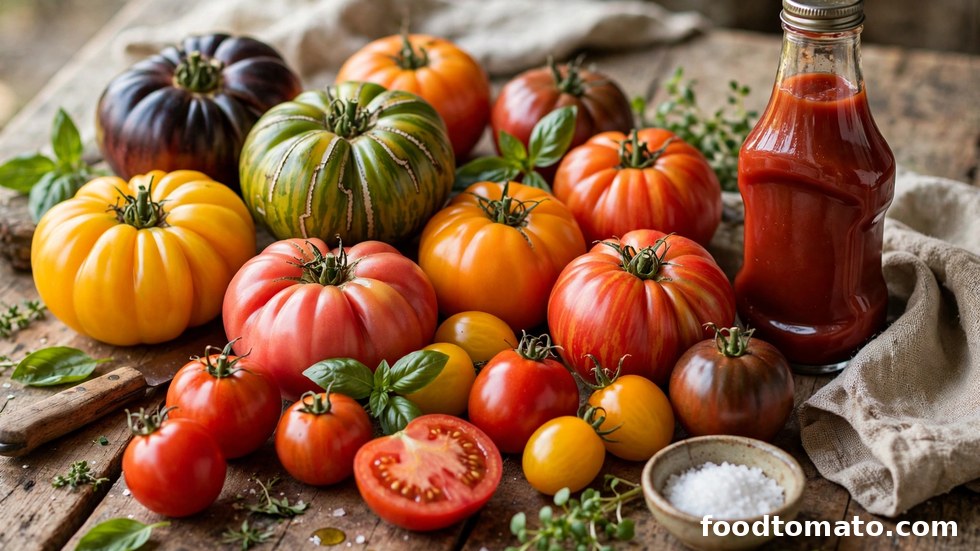
Brandywines, Cherokee Purples, Green Zebras, Pineapple tomatoes — heirloom tomatoes are the rock stars of the garden, and they deserve better than a store-bought bottle. Turning them into ketchup is the single best way to capture peak-season flavor in a jar, because heirloom varieties have a sweetness and complexity that regular supermarket tomatoes simply cannot match. If you grow heirlooms, this recipe is their crowning achievement.
This guide covers everything about heirloom tomato ketchup: which varieties to use, how to adjust for their sweetness and juiciness, the full process, and how to preserve every jar.
- Why Heirloom Tomatoes Make Superior Ketchup
- Best Heirloom Varieties for Ketchup
- Adjusting the Recipe for Heirlooms
- Heirloom Tomato Ketchup Recipe
- Seasoning and Tasting Like a Pro
- Preserving Your Harvest: Storage and Canning
- FAQs
Why Heirloom Tomatoes Make Superior Ketchup
Heirloom tomatoes were bred for flavor, not shipping durability. Unlike commercial tomatoes picked green and gassed to red, heirlooms ripen fully on the vine, developing high natural sugars and a rich, almost fruity acidity. That flavor advantage carries straight into ketchup — you will taste it in the very first spoonful.
Heirlooms also tend to be less uniformly acidic than paste tomatoes, giving your ketchup a rounder, more layered taste instead of a one-note tang. Their higher water content just means a bit more cooking time.
And ketchup is the perfect use for imperfect fruits: split, cracked, or oddly shaped heirlooms too ugly for salad but just as tasty. Never throw them away — ketchup them.
Best Heirloom Varieties for Ketchup
Here are the standouts for ketchup, judged on flavor, color, and how they cook down:
- Brandywine — intensely sweet, low-acid pink beefsteak; makes a lush, velvety ketchup.
- Cherokee Purple — dusky, smoky-sweet flesh that adds remarkable depth.
- Mortgage Lifter — huge, meaty fruits that reduce quickly.
- Amish Paste — technically an heirloom paste tomato; lower water content means less reduction time.
- Black Krim — salty-sweet and complex; a little goes a long way when blended with others.
The best strategy is blending: mix 2 or 3 varieties to balance sweetness, acidity, and color. A 50/50 mix of Brandywine with Cherokee Purple makes ketchup like nothing you have ever bought.
Adjusting the Recipe for Heirlooms
Heirloom ketchup is not a different recipe — it is a tuned version of the standard recipe. Three adjustments matter:
- Less added sugar: heirlooms are much sweeter than paste tomatoes. Start with half the usual sugar (about 1/4 cup per 5 lbs of tomatoes) and add more only if needed after cooking.
- Longer reduction: heirlooms are juicier. Plan for 30 to 45 extra minutes of simmering compared to a Roma-based batch.
- Vinegar stays the same: keep the full 3/4 cup of apple cider vinegar per 5 lbs. The acidity is essential for flavor balance and for safe canning.
If you want to understand the underlying ratios before you start tweaking, the breakdown of essential ingredients for perfect homemade ketchup explains exactly what each component contributes, from sugar to spices to salt.
Heirloom Tomato Ketchup Recipe
This recipe yields about 5 half-pint jars (roughly 2.5 quarts) of finished ketchup.
Ingredients
- 5 lbs ripe heirloom tomatoes, cored and quartered (a mix of varieties is ideal)
- 1 large onion, chopped
- 3 cloves garlic, minced
- 3/4 cup apple cider vinegar (5% acidity)
- 1/4 to 1/3 cup brown sugar (start low — you can add more later)
- 1 tablespoon tomato paste (helps deepen the color)
- 1 teaspoon salt
- 1 teaspoon dry mustard
- 1/2 teaspoon cinnamon
- 1/2 teaspoon allspice
- 1/4 teaspoon cloves, ground
- 1/4 teaspoon black pepper
- 1 bay leaf
Step 1: Simmer the vegetables
Combine the tomatoes, onion, and garlic in a large heavy-bottomed pot. Cook over medium heat for 30 to 40 minutes, stirring occasionally, until everything is very soft and the tomatoes have released their juices.
Step 2: Add the vinegar and spices
Stir in the vinegar, brown sugar (start with 1/4 cup), tomato paste, salt, dry mustard, cinnamon, allspice, cloves, pepper, and the bay leaf. Continue simmering uncovered over low heat.
Step 3: Blend smooth
Remove the bay leaf and blend until completely silky, then push it through a fine-mesh sieve to remove seeds and skins. Heirlooms have prominent seeds, so do not skip this step for store-smooth ketchup.
Step 4: Reduce to ketchup
Return the strained sauce to the pot and simmer on low for 60 to 90 minutes, stirring frequently, until a spoonful mounds on a plate with no watery ring around it.
Step 5: Taste and fine-tune
This is where the magic of heirloom ketchup happens. Taste the batch and adjust: more sugar if it is too sharp, a splash of vinegar if it is too sweet, a pinch of salt to wake up the tomato flavor. Different variety blends need different tweaks, so trust your tongue.
New to the whole process? The classic homemade tomato ketchup recipe step by step walks through the same core technique in detail, and the small batch ketchup recipe for beginners is perfect if you want to trial your heirloom blend in a single pot before committing the whole harvest.
Seasoning and Tasting Like a Pro
Heirloom tomatoes vary wildly in sweetness and acidity, so treat seasoning as a conversation with your batch. Taste in this order:
- Salt first: it amplifies the natural tomato flavor.
- Then vinegar: the bright tang that makes it taste like ketchup.
- Sugar last: only as much as needed to round off sharp edges.
- Spices with restraint: cinnamon and clove can easily overpower delicate heirloom flavor — add pinches, not spoonfuls.
Always taste on a cool spoon — heat dulls sweetness and magnifies spice.
Preserving Your Harvest: Storage and Canning
Cool the finished ketchup completely and funnel it into sterilized bottles. Refrigerated, it keeps for 3 to 4 weeks.
For shelf storage, water-bath can the ketchup: ladle it hot into hot half-pint jars with 1/2 inch of headspace and process for 15 minutes (adjust for altitude). Because heirlooms can be lower in acid, never reduce the vinegar.
Sealed jars keep in a cool, dark pantry for up to a year. Label each jar with the variety blend so you can repeat the winners next season.
FAQs
Can I use green heirloom tomatoes like Green Zebra?
Green varieties make a tangier ketchup and work best blended with red heirlooms — try a 1:2 green-to-red ratio.
Do I really need to strain out the seeds?
Heirlooms have large, tough seeds that survive blending — strain through a fine-mesh sieve for a smooth texture.
My heirloom ketchup is brownish instead of red. What happened?
Dark varieties like Cherokee Purple and Black Krim naturally produce a deeper, browner ketchup. It is completely normal and usually tastes better. For a brighter color, blend in more red varieties.
Can I freeze heirloom ketchup?
Yes — freeze in jars or freezer bags with headspace for up to 6 months. Thaw in the fridge and stir well.
How do I know which variety blend I liked best?
Keep a simple garden journal: note the varieties, their proportions, and your taste rating. Next season you will know exactly which combination to plant more of.