
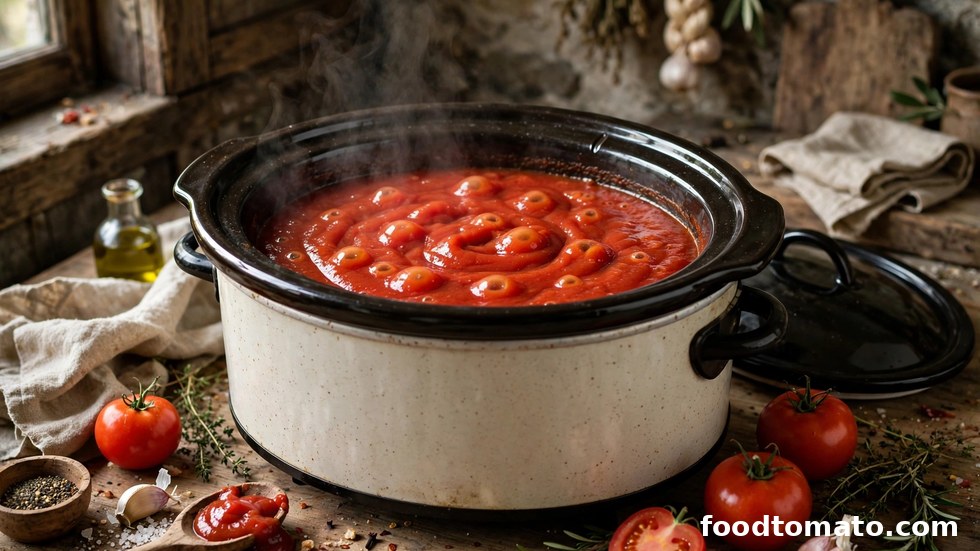
Most ketchup recipes ask you to stand over a sputtering pot for two hours, stirring constantly while hot tomato splatter threatens to redecorate your kitchen. This slow cooker ketchup turns that whole chore upside down: load your crockpot in the morning, walk away, and come back to rich, thick homemade ketchup that practically cooked itself.
In this guide you will get the full set-and-forget slow cooker ketchup recipe — the exact ingredients, the right crockpot settings, how to thicken the ketchup at the end, and safe ways to store or can it. By the end you will know how to make ketchup that tastes deeper and sweeter than anything from the stove.
- Why a Slow Cooker Makes Better Ketchup
- Slow Cooker Ketchup Ingredients
- The Recipe: Step by Step
- How to Get the Perfect Thickness
- Flavoring Variations to Try
- Storing and Canning Your Ketchup
- FAQs
Why a Slow Cooker Makes Better Ketchup
The slow cooker is secretly the ideal ketchup-making tool thanks to gentle, even heat. Tomatoes scorch easily on the stovetop because they are high in natural sugars; in a crockpot, heat surrounds the food evenly, so there is almost no risk of burning and you never need to hover with a spoon.
Long, gentle heat also lets tomatoes caramelize slowly, concentrating their sweetness and building a depth that a 45-minute stovetop simmer cannot match.
Then there is the hands-off convenience: load the crockpot in the morning and let it work. The recipe below takes about 10 hours but only 15 minutes of actual work from you.
Slow Cooker Ketchup Ingredients
This recipe makes about 2 quarts (roughly 6 standard ketchup bottles) of finished ketchup. Scale it to your crockpot size — a 6-quart slow cooker fits this batch comfortably.
- 6 lbs fresh tomatoes (Roma or plum tomatoes are best), quartered
- 2 medium onions, quartered
- 4 cloves garlic, smashed
- 1 cup apple cider vinegar (5% acidity)
- 3/4 cup brown sugar (lightly packed)
- 2 tablespoons molasses — the secret to that classic ketchup depth
- 1 tablespoon salt
- 1 teaspoon dry mustard
- 1 teaspoon smoked paprika
- 1/2 teaspoon cinnamon
- 1/2 teaspoon allspice
- 1/2 teaspoon black pepper
- 2 whole cloves (in a spice bag or tea infuser for easy removal)
- 1 bay leaf
If you are new to building a ketchup recipe from scratch, reading about the essential ingredients for perfect homemade ketchup will help you understand what each spice does, so you can tweak confidently.
The Recipe: Step by Step
Step 1: Load the slow cooker
Add the quartered tomatoes, onions, and garlic to your slow cooker. Pour in the apple cider vinegar, then stir in the brown sugar, molasses, salt, dry mustard, smoked paprika, cinnamon, allspice, and black pepper. Tuck in the bay leaf and the spice bag with the cloves. Stir everything together so the sugar and spices coat the vegetables.
Step 2: Cook low and slow
Cover and cook on LOW for 8 hours (or HIGH for 4 hours if you are in a hurry). The vegetables will release a lot of liquid and soften into a soupy sauce. This is normal — the thickening comes later. If your slow cooker lid is not a tight fit, the ketchup will reduce a little more on its own.
Step 3: Remove the spices and blend
Fish out the bay leaf and the clove bag. Use an immersion blender right in the crockpot to blend the mixture until completely smooth. If you do not own an immersion blender, let the mixture cool for 20 minutes and blend in batches in a regular blender, filling it only halfway and holding the lid firmly with a towel.
Step 4: Reduce with the lid off
Set the lid back on slightly ajar (a wooden spoon wedged under it works perfectly) so steam escapes, and cook on HIGH for 2 to 3 more hours, stirring every 30 to 45 minutes. It is done when a spoonful holds its shape on a plate without watery liquid pooling around the edges.
Step 5: Taste and adjust
Now season like a chef: more vinegar if it needs tang, brown sugar if too tart, salt if too sweet. Homemade ketchup rewards last-minute seasoning.
If you are making a smaller batch first to test the flavors, this small batch ketchup recipe for beginners is a great low-risk starting point before committing to a full crockpot.
How to Get the Perfect Thickness
A good benchmark is that ketchup should flow slowly off a spoon and mound slightly before settling. Slow cooker ketchup thickens mainly by evaporation during the lid-off stage, so time is your primary tool — but you have options.
- More evaporation: leave the lid ajar longer, or switch to a wide saucepan on the stove for the last 30 minutes to speed reduction.
- Tomato paste: stir in 2 to 3 tablespoons of tomato paste during the final hour to deepen color and body.
- Don’t rush it: ketchup that looks slightly thin in the pot will thicken further as it cools and even more in the fridge.
- Strain for silkiness: push the blended ketchup through a fine-mesh sieve to remove seeds and skins for a store-smooth texture.
Flavoring Variations to Try
Once you have the base technique down, try flavor experiments — use the classic homemade tomato ketchup recipe proportions as your starting point:
- Smoky chipotle ketchup: add 1 to 2 chipotle peppers in adobo sauce during the cook.
- Spicy sriracha-style ketchup: stir in 2 tablespoons of sriracha or 1 teaspoon cayenne at the end.
- Curry ketchup: add 2 tablespoons of curry powder with the other spices — amazing on fries.
- Balsamic ketchup: replace half the apple cider vinegar with balsamic for a darker, fruitier condiment.
- Garlic-lover’s ketchup: double the garlic and roast it first for sweetness.
Storing and Canning Your Ketchup
Cool the ketchup completely and funnel it into sterilized bottles or jars. It keeps in the refrigerator for up to 3 weeks.
For longer storage, this recipe suits water-bath canning: ladle hot ketchup into hot half-pint jars, leaving 1/2 inch of headspace, process for 15 minutes, and store sealed jars for up to a year.
FAQs
Can I make this ketchup without a slow cooker?
Absolutely. Simmer everything in a heavy Dutch oven on the lowest heat for 2 to 3 hours, then blend and reduce. You will just need to stir more often to prevent scorching.
Do I have to peel the tomatoes first?
No. Since you blend and strain the finished ketchup, the skins break down completely.
Can I use canned tomatoes instead of fresh?
Yes — use two 28-ounce cans of crushed or whole peeled tomatoes. Reduce the cooking time on LOW to about 6 hours, since canned tomatoes are already cooked.
Is slow cooker ketchup safe for water-bath canning?
Yes, as written: the apple cider vinegar keeps the acidity at a safe level. Do not reduce the vinegar, and always use 5% acidity vinegar for safe canning.
Why does my ketchup taste better after a day in the fridge?
The spices and vinegar need time to meld — ketchup tastes best 24 to 48 hours after making it.