
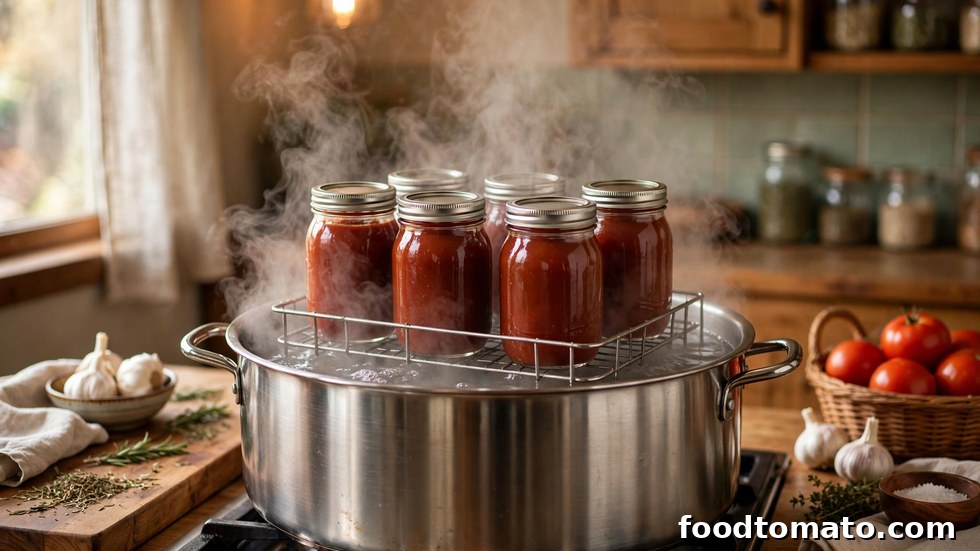
There is nothing quite like a pantry shelf lined with your own homemade ketchup — ruby-red jars of summer tomatoes waiting to rescue a plate of fries in the middle of January. Water bath canning makes that possible, and it is far less intimidating than it looks. If you can boil water and fill a jar, you are most of the way there. What matters is following a few non-negotiable rules about acidity, processing time, and sealing, because ketchup is a tomato product, and tomato products must be acidic enough to can safely. This guide walks you through the whole process, from prepping jars to hearing that satisfying “ping” of a sealed lid.
Why Water Bath Canning Works for Ketchup
Water bath canning works by submerging filled jars in boiling water (212°F / 100°C at sea level) for a specified time. That sustained heat destroys molds, yeasts, and bacteria, forces air out of the jar, and creates a vacuum seal as the contents cool. It is approved for high-acid foods — foods with a pH of 4.6 or below. Tomatoes sit right on that line, so canning authorities recommend adding bottled lemon juice or citric acid to every jar to guarantee safety. Ketchup recipes already include vinegar, which helps, but the added acid per jar is the extra step that makes your ketchup reliably safe.
You must use a tested recipe for the ketchup itself — one from the National Center for Home Food Preservation, a Ball canning guide, or another reputable tested source. Do not water bath can a ketchup made from an untested recipe with extra onions, peppers, or low-acid vegetables, because those raise the pH. If your favorite recipe is not tested for canning, still make it — just refrigerate or freeze it instead.
Equipment You Need
- Water bath canner with a rack (or a deep stockpot at least 4 inches taller than your jars, plus a rack or folded towel on the bottom)
- Half-pint (8 oz) or pint (16 oz) canning jars with two-piece lids (flats and bands)
- Jar lifter, canning funnel, headspace tool or ruler, bubble remover, and a lid wand
- Large saucepan or Dutch oven for the ketchup itself
- Ladle, clean damp cloths for wiping rims
- Bottled lemon juice or citric acid
- Towels and a stable counter space for cooling jars undisturbed for 12–24 hours
Use only proper canning jars — grocery-store jam jars may not seal reliably. Buy new flat lids every time, since the sealing compound is single-use; bands can be reused as long as they are not rusty or bent.
Prepare Your Jars and Canner
Start with the canner. Put the rack in the bottom, arrange your empty jars on it, and fill the canner with hot water so the jars are covered by at least an inch. Bring it to a simmer (180°F / 82°C). You do not need to sterilize jars for ketchup because the processing time exceeds 10 minutes — the simmer is just to keep them hot so hot ketchup does not thermal-shock cold glass. Put your flat lids in a small saucepan of hot (not boiling) water and keep them there until use. Wash bands and set them aside.
For every half-pint jar, add 1 tablespoon of bottled lemon juice; for every pint, add 2 tablespoons — directly into each jar before filling, or stirred into the batch (1/4 cup per quart of ketchup). Bottled juice is specified because its acidity is consistent. Alternatively, use 1/4 teaspoon of citric acid per pint.
Step-by-Step: Canning Your Ketchup
- Cook the ketchup. Prepare your tested ketchup recipe and bring it to a full rolling boil, stirring frequently. It should be piping hot when it goes into jars — never can lukewarm ketchup.
- Fill the jars. Working one jar at a time with your funnel, ladle hot ketchup into a hot jar, leaving 1/2 inch of headspace (the space between the ketchup surface and the rim).
- Remove air bubbles. Slide the bubble remover tool around the inside of the jar to release trapped air, then recheck and adjust the headspace.
- Wipe the rims. Dip a clean cloth in hot water, wring it out, and wipe each jar rim thoroughly. Any residue of sugar or tomato can prevent a seal.
- Apply the lids. Center a hot flat lid on the jar and screw the band on fingertip-tight — firm, but not cranked down. Air needs to escape during processing.
- Load the canner. Lower each jar into the boiling water with the jar lifter, keeping jars upright and not touching. The water must cover the jars by at least 1–2 inches; add boiling water if needed.
- Process. Start timing when the water returns to a full rolling boil. Process half-pint and pint jars for 15 minutes (adjust for altitude — see the table below).
- Cool undisturbed. Turn off the heat, remove the canner lid, and let jars rest in the water for 5 minutes. Lift them out, set them upright on a towel, and leave them alone for 12–24 hours. You will hear the lids pop as they seal.
- Check the seals. After cooling, press the center of each lid. It should not flex or pop. Remove the bands, lift each jar by the lid edge to confirm the seal holds, then wipe the jars, label them, and store in a cool, dark place.
Processing Times and Altitude Adjustments
At higher altitudes water boils at a lower temperature, so processing time must increase. Find your elevation and use the corresponding time for both half-pint and pint jars of ketchup:
| Altitude | Processing time (half-pint and pint) |
|---|---|
| 0–1,000 ft (0–300 m) | 15 minutes |
| 1,001–3,000 ft (301–900 m) | 20 minutes |
| 3,001–6,000 ft (901–1,800 m) | 25 minutes |
| Above 6,000 ft (1,800 m) | 30 minutes |
Quart jars are not recommended for ketchup — heat penetration to the center of a large jar of sauce is unreliable, so stick to half-pints or pints.
Safety Notes That Are Not Optional
Ketchup is a low-risk canning project only when the rules are followed. Use a tested recipe without low-acid add-ins. Add the bottled lemon juice or citric acid every time. Process the full time for your altitude. Never reduce the processing time because your ketchup “looks thick enough.” And if a jar does not seal within 24 hours, refrigerate it and use it within a few weeks, or reprocess within 24 hours with a new lid for the full time.
Tips for Great Results
Keep everything hot
Hot ketchup into hot jars into boiling water is the golden rule. If your ketchup cools while you are filling jars, bring it back to a boil before continuing — cold spots in a jar can mean under-processed pockets.
Can in small batches
Half-pint jars are the sweet spot for ketchup — they process quickly, they are the right size once opened (ketchup keeps only a few weeks after opening), and they make great gifts.
Store bands off the jars
Once seals are confirmed, remove the bands before storing. Bands left on can rust and trap moisture — worse, they can hold a failed lid in place, hiding a broken seal. A lid held by vacuum alone is the true test.
Troubleshooting
My lids did not seal. What now?
First, check the obvious: dirty rims, over-tightened bands, chipped jar rims, or old lids. Within 24 hours you may reprocess the jar with a new lid for the full processing time, or simply refrigerate it and use it within 3–4 weeks.
Ketchup leaked out during processing (siphoning). Is it safe?
Siphoning usually comes from rapid temperature changes or over-tightened bands. If the jar still sealed and lost only a little, it is fine. If it did not seal, refrigerate and use soon.
My ketchup darkened in the jar. Is that normal?
Slight darkening over months of storage is normal and harmless — oxidation and caramelization of sugars. Store jars in a cool, dark place to slow it, and use within a year for best quality.
Key Takeaways
- Water bath canning is safe for ketchup only with a tested recipe, added bottled lemon juice or citric acid, and the full processing time for your altitude.
- Process half-pint and pint jars for 15 minutes at sea level, adding 5 minutes per altitude band up to 30 minutes above 6,000 feet.
- Keep the chain hot — hot ketchup into hot jars into boiling water — and leave 1/2 inch of headspace with clean, fingertip-tight lids.
- Check every seal after 24 hours, store bands off, and refrigerate any unsealed jar for use within a few weeks.
Canning your own ketchup is one of the most satisfying things a home cook can do — a whole summer of tomatoes condensed into jars that keep for a year. Follow the tested steps above and you will can with complete confidence. Next, read our storage guide to learn exactly how long those sealed jars last, and browse the site for more ketchup recipes to fill your next batch of jars.
2 thoughts on “How to Can Tomato Ketchup Safely (Water Bath Method)”